Brownstone is soft: what restorers patch
The chocolate fronts of Cobble Hill and Carroll Gardens are mostly a thin skin of soft sandstone, and much of what you see today is careful repair. Here is how to tell.
- Neighbourhood
- Brooklyn
- On foot
- About 45 minutes
- Subway
- Bergen St, F and G trains
- Best months
- Late autumn and early spring
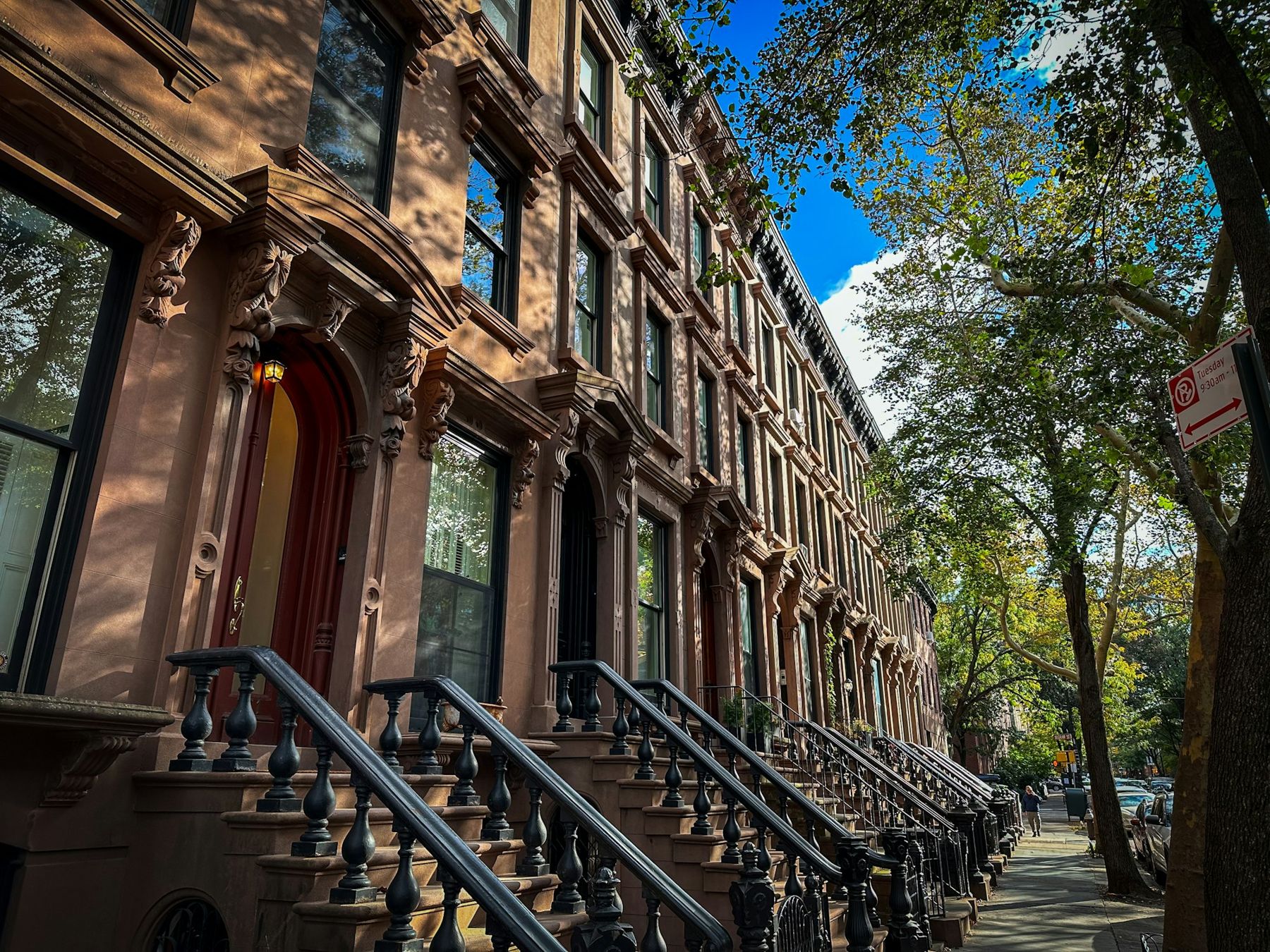
From across the street a brownstone row looks solid, dark and permanent. Up close it is something else: a thin facing of soft sandstone, a few inches deep, laid over a brick wall. The stone is easy to carve and quick to wear, and almost every front you pass in brownstone Brooklyn has been patched, rebuilt or resurfaced at least once. Once you know the signs, a walk through Cobble Hill or Carroll Gardens becomes a tour of repairs.
A stone made of mud
Brownstone is a sandstone formed in the Triassic and early Jurassic, when rivers dumped sand and silt into long basins along what is now the Connecticut River valley and northern New Jersey. Iron oxide in the grains gives it the colour, from purple-brown to a warm pinkish tan. The most famous quarries were at Portland, Connecticut, on the Connecticut River, where the stone could be loaded straight onto boats; New Jersey quarries supplied a great deal more.
Sandstone settles in layers, called beds. Laid flat, the way it lay in the ground, each block carries weight across its beds and sheds water well. The trouble is that a block split along its beds gives a nice broad face to show the street. So builders often turned the blocks on edge, with the layers standing upright and parallel to the front of the house. This is called face-bedding, and it is the root of most of what you will see on this walk.
How the damage happens
Water gets into a face-bedded block between the layers. In winter it freezes and expands, and over many years the outer layer lifts like the page of a damp book. Eventually a sheet of stone the thickness of a biscuit falls away, which is called spalling. The fresh surface behind it starts the process again. Salts from the soil and from de-icing on stoops add to it, and so do the iron cramps that tied the facing to the brick: when iron rusts it swells and cracks the stone around it.
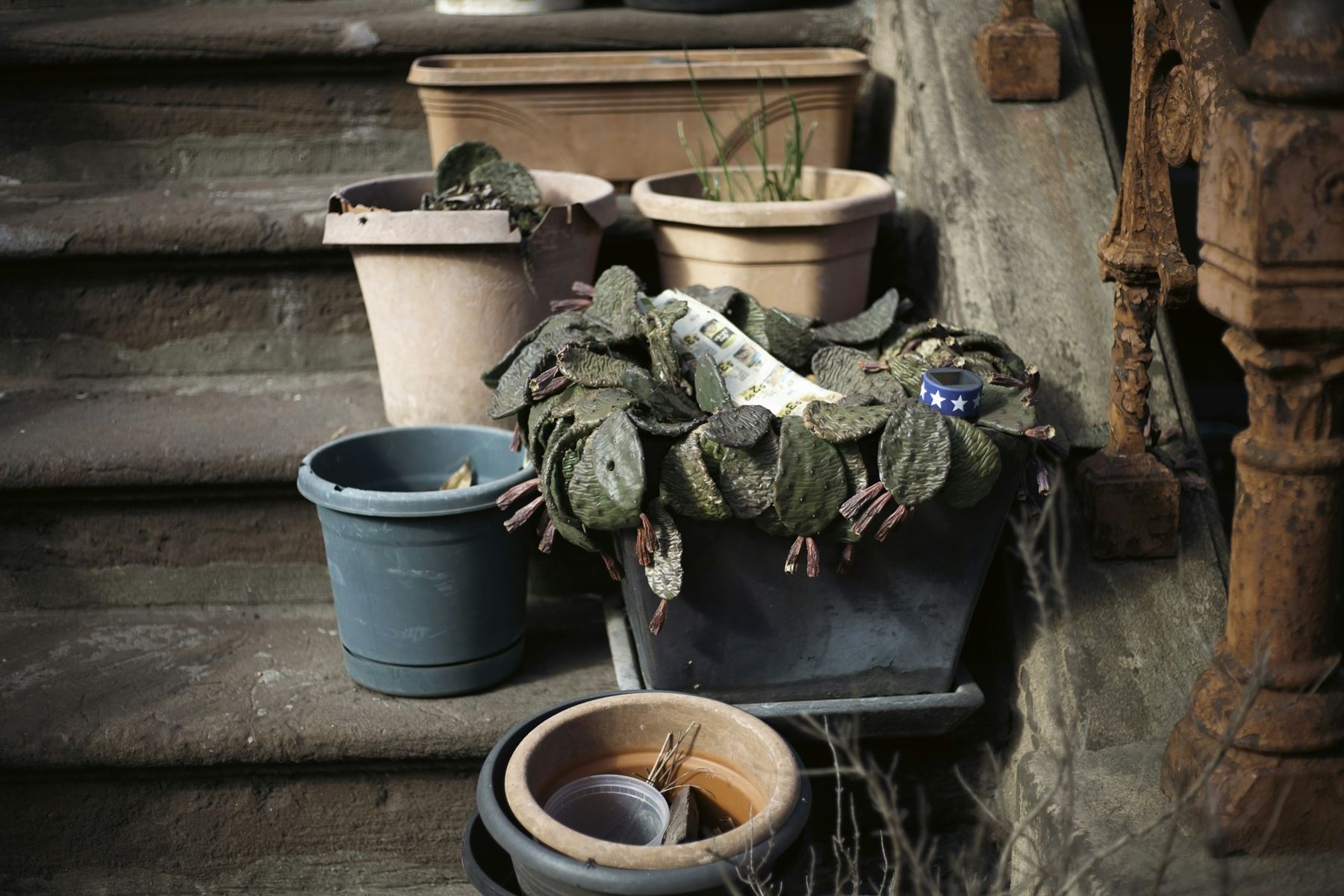
The damage is worst where water sits. Look at the tops of window lintels, the horizontal stones over each window; at sills, the ledges below; at the cornices and hoods over doors; and above all at the stoop, the high front stair, where every tread takes rain, snow, salt and feet. A good stoop is often the most rebuilt part of the house, which is worth remembering when you read why the front door is up a flight.
What restorers do
The big quarries closed long ago, and matching blocks are hard to find, so most brownstone repair is done with mortar rather than new stone. Two methods do most of the work: patching and the dutchman. For a patch, the restorer cuts back loose and flaking stone to a sound surface, sets small stainless-steel pins or wire into the wall to hold the new material, and builds up a mortar mixed with crushed stone and pigment in layers, then shapes and tools the surface to match the original. Done well, it is very hard to spot. A dutchman is a piece of real stone set into a cut-out hole, like a patch on a sleeve.
Carved work is harder. A lost leaf or bracket may be modelled in place by hand, or cast in a mould taken from a surviving neighbour. Where a whole front has failed, owners have sometimes stripped it back and resurfaced the entire facade in tinted mortar, scored with lines to imitate the joints between blocks. In the twentieth century many owners simply shaved off the carving and covered the front in plain stucco, which is why some rows have one bald house among ornamented ones.
In a historic district, work on a facade generally needs approval from the Landmarks Preservation Commission, which sets standards for colour, texture and detail. The rules are specific and change over time, so treat what you see as the result of many different eras of taste.
Brownstone · Field noteWhy the front door is up a flightThe walk: Cobble Hill
Start at Bergen Street and walk west into Cobble Hill. The streets between Court Street and Hicks Street, and the short side places such as Tompkins Place and Strong Place, hold long runs of brownstone and brick row houses from the middle of the nineteenth century. Take a single block slowly and look at each house in turn rather than at the row.
Watch the colour first. Original stone weathers unevenly: darker in sheltered corners, paler where rain washes it, with a faint visible grain. Patches tend to be more uniform, and they age in their own way, often drifting redder or greyer than the stone beside them. Then watch the texture. Real brownstone shows fine bedding lines and tiny pits; mortar can look smooth, slightly sugary, or tooled with a regular pattern of strokes.
Carroll Gardens and the deep front yards
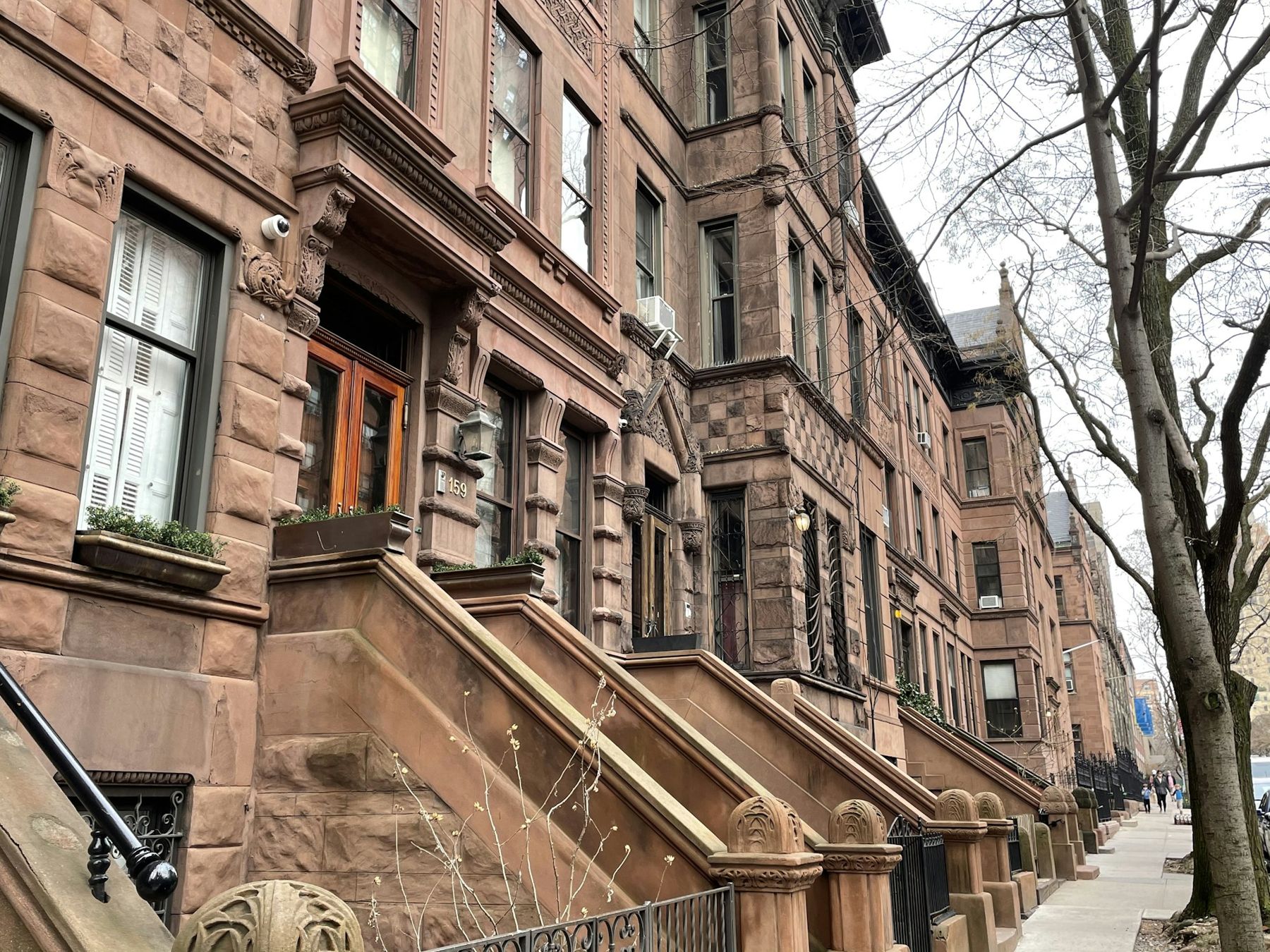
Cross south toward Carroll Gardens, where several streets have unusually deep front gardens between the houses and the pavement. The distance is useful: you see the whole facade at once, from the stoop to the cornice, and you can compare neighbours easily. Look along a row for the line of window hoods. Where one house has crisp, sharp-edged hoods and its neighbours have softened ones, the sharp set is probably newer work, cast or rebuilt. Where a hood has the right outline but no carving inside it, someone has saved the shape and given up the ornament.
Check the joints. Real brownstone fronts were laid in blocks with very fine joints. A resurfaced front often has scored joints that are too regular, too deep, or that run in a grid where the original stones would never have lined up. Look also for hairline cracks around the edge of a patch, where new material has pulled away from old, and for rust stains bleeding from a crack, which mean an iron fixing is still at work inside.
Reading the result
None of this is a criticism of the houses. A brownstone front is a running repair, and the best work is invisible from the pavement. The point of noticing is to understand what you are looking at: a material chosen for warmth and ease of carving, laid in a way that guaranteed trouble, and kept going by a long trade of patchers, carvers and casters.
If you want to see how other stones fail, the story on how limestone weathers in city air shows a harder, paler stone with its own problems, and iron or stone explains how to tell a painted cast-iron front from real masonry. For the full range of brownstone in one district, Harlem's rows are a good next walk.
These are private houses. Look from the pavement, do not climb stoops or lean into front gardens, and never pick at loose stone, however tempting a lifting flake may be.
Every photograph on this page is credited, with its licence, on Masons of the lens.