How limestone weathers in city air
Indiana limestone covers much of Midtown, and every front records the city's air. Learn to read black crusts, pale rain-washed streaks, flaking edges and the marks of cleaning.
- Neighbourhood
- New York
- On foot
- An hour or so
- Subway
- 34 St-Herald Sq, B D F M
- Best months
- Overcast days in any season

Limestone is the city's dress stone. From the Empire State Building to the side streets of the Upper East Side, a pale buff limestone, most of it from southern Indiana, covers the fronts of thousands of buildings. It was chosen because it is even in colour, easy to cut into large blocks and soft enough to carve, and because it looks expensive without being as costly as marble or granite. It also happens to be a stone that reacts with the air. Every limestone front in New York is a record of what the city has been breathing.
What Indiana limestone is
The stone formed on the floor of a warm, shallow sea several hundred million years ago. It is made largely of calcite, mostly in the form of broken shells and the skeletons of tiny sea creatures, packed and cemented together. Step up close to a ground-floor wall and you can often see them: small rings, specks and fragments in a fine, sandy background. The stone comes in two common colours, a warm buff and a cooler grey, and builders sometimes mixed them, which is one reason a front can look patchy even when it is clean.
Calcite is the key to everything that follows. It dissolves slowly in acid, and city air has always carried acids: from coal smoke, from oil furnaces, from traffic. The stone is quietly reacting with the weather every day.
Black crusts and pale washes
The most striking pattern on old limestone is black and white side by side. Look at a cornice, a window head or a carved ledge. On the surfaces that rain hits and runs off, the stone is often pale, sometimes paler than new. In the sheltered places just below, under the ledge, behind a column or in the hollow of a carving, it is often dark grey or black.
Both are weathering, and they are two sides of the same chemistry. Sulphur from burning coal and oil turned into sulphuric acid in damp air. Where that acid reached the stone and stayed, it converted the calcite at the surface into gypsum, a soft mineral that traps soot and dust and forms a hard black crust. Where rain washed the surface regularly, the gypsum dissolved away as fast as it formed, taking a thin layer of stone with it and leaving a clean, slightly worn face.
So the pale parts of an old front are not untouched. They are the parts that have been slowly eroded. The black parts are where the stone has been slowly converted into crust. Once you see this, every building turns into a map of where water goes.
Limestone · WalkFifth Avenue's pale mileSugaring, scaling and spalling
Look closer at the edges of old carving. On limestone that has been weathering for a century, sharp arrises, the crisp edges where two faces meet, soften and round off. Fine details lose their outlines. On some stones the surface turns granular and powdery, a condition often called sugaring, because the grains come away like sugar when brushed. It is more common and more dramatic on marble, which weathers grain by grain, but you will see it on limestone too.
Crusts cause their own damage. A gypsum crust has different properties from the stone beneath, and over time it can blister and peel away, pulling a thin skin of stone with it. This is called scaling. Deeper damage, where whole pieces break off, is called spalling, and in limestone it is most often caused by iron. Old buildings used iron cramps and anchors to tie the stone to the structure; when water reaches the iron it rusts, swells and cracks the stone around it. A brown stain bleeding from a crack is a good sign of rusting metal inside.
The cleaning campaigns
For much of the twentieth century, New York was a black city. Coal heating and industry coated limestone fronts with soot, and photographs of Midtown from the middle of the century show many buildings far darker than they are now. Air quality improved greatly as coal burning declined and controls on pollution tightened, and from the 1970s onward many owners began to clean their fronts.
How a building was cleaned matters a great deal. Early efforts sometimes used abrasive blasting or strong chemicals, which can pit the surface, round off carving and strip the outer layer of stone along with the dirt. Today, conservators generally favour gentler methods: low-pressure water, fine mists left to soften a crust over hours, steam, and poultices, pastes spread on the stone to draw the dirt out. On a building in a historic district, cleaning usually needs approval from the Landmarks Preservation Commission, which sets standards for methods. Rules and approved techniques change, so if you are curious about a specific building, look for the permits posted at its scaffolding.
Blocks worth the detour
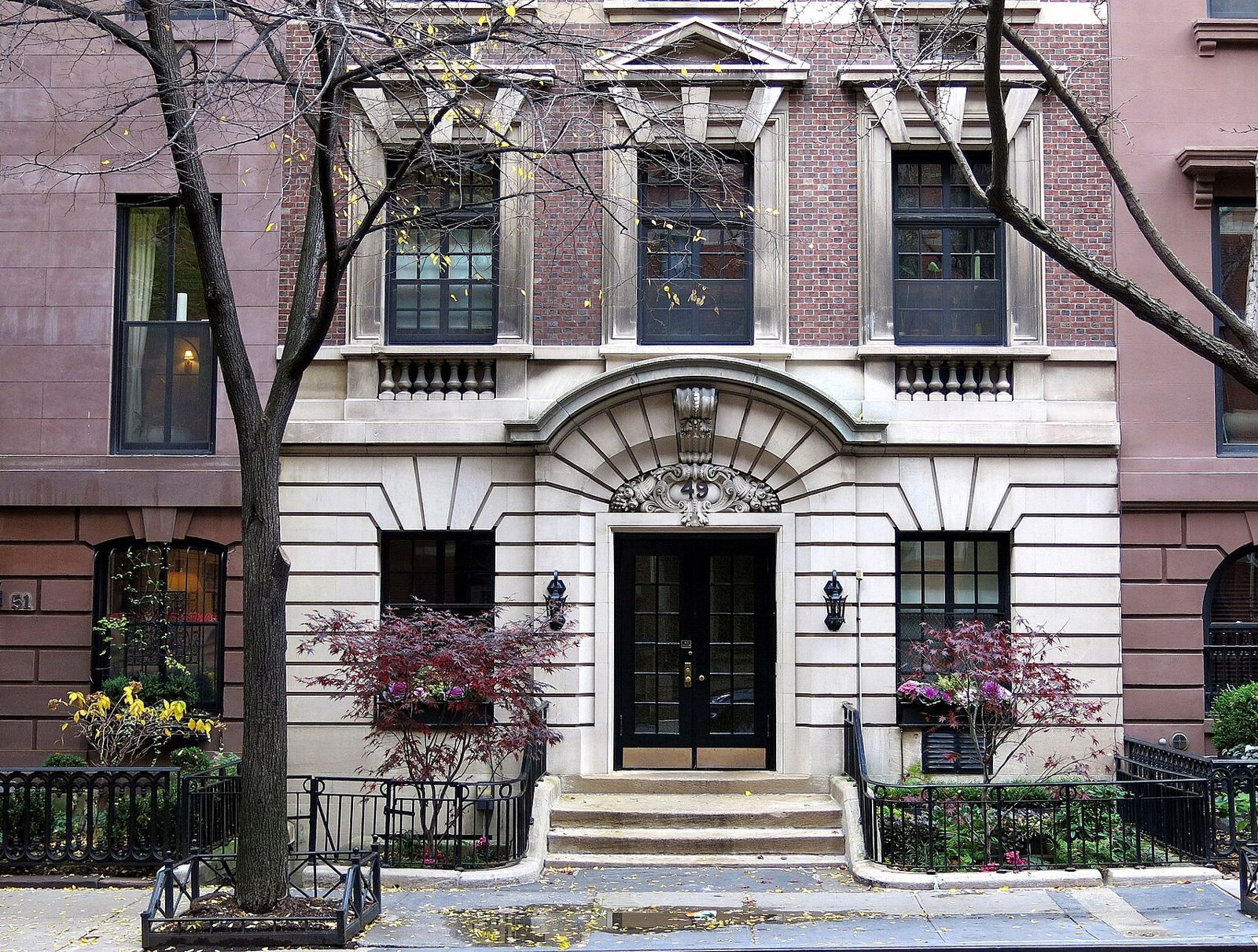
Walk Fifth Avenue north from 34th Street. The Empire State Building, finished in 1931, is clad in Indiana limestone with vertical strips of metal between the windows; look at how the stone has aged compared with the metal, and at the setbacks, where ledges shelter the walls below. Further north, between the library and Central Park, compare neighbouring buildings and you will often find one recently cleaned beside one that has not been. The contrast is clearest at cornices, where the cleaned building shows crisp pale stone and the other a band of grey under the overhang.
Look also at places where a scaffold has just come down. Newly cleaned limestone can look almost raw, and new patches and replacement blocks stand out for a few years before the weather evens them in. Repairs are made with tinted mortars shaped to match, or with new stone set into the old wall; the method is close to the one described for softer stone in brownstone repair.
The walk along Fifth Avenue's pale mile passes many of the best examples, and the south front of Grand Central shows limestone and granite working together on a monumental scale. If you are unsure whether a pale front is stone at all, iron or stone explains how to tell from the pavement.
Whatever you look at, look from the pavement. Never scrape or rub at a crust to see what is underneath; even a fingernail can take off a surface that has lasted a century.
Every photograph on this page is credited, with its licence, on Masons of the lens.