Fifth Avenue's pale mile
From the library at 42nd Street to Grand Army Plaza, Fifth Avenue is built of pale stone. Learn to tell marble from limestone and to read what each was asked to do.
- Neighbourhood
- Fifth Avenue
- On foot
- About 90 minutes
- Subway
- 5 Av, 7 train
- Best months
- October, November, April, May
Fifth Avenue between 42nd and 59th Streets is a corridor of pale stone. Seen quickly from a bus it is all one colour, a warm off-white with shop windows set into it. Walked slowly, it splits into several materials with different characters: crisp white marble, creamy limestone with tiny fossils in it, pinker granite at the bases, and here and there bronze and gilding. This walk goes north for about seventeen blocks and teaches you to tell them apart.
Start early. By late morning the pavements are crowded, and you will want room to stop, step back and look up.
The library: marble on the steps
Begin at the Stephen A. Schwarzman Building, the main building of the New York Public Library, which fills the west side of Fifth Avenue from 40th to 42nd Street. It opened in 1911, designed by the architects Carrere and Hastings in the Beaux-Arts style, and it is the first lesson of the walk because it is not limestone. The walls are white marble, and marble is a different stone: limestone that has been changed by heat and pressure deep in the earth until its grains recrystallised. It is harder and denser, takes a finer polish, and from close up has a faint sparkle where crystals catch the light.
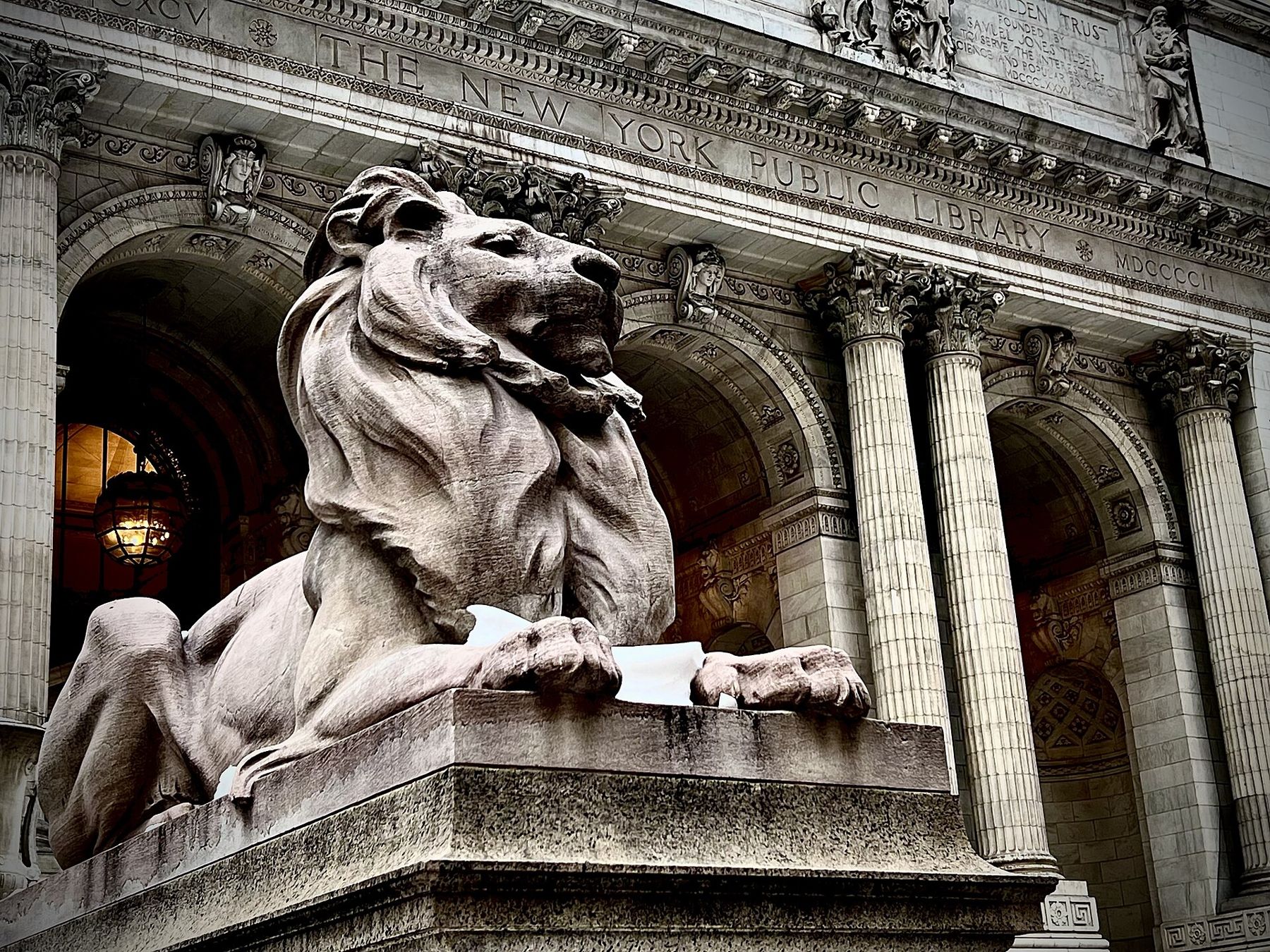
Stand on the steps and look at the two lions on their pedestals. They are carved from a pinker marble, and they have names: Patience on the south side and Fortitude on the north. Look at how the carver has handled the manes, deep, smooth and rounded, and at the weathering on the pedestals beneath, where rain running off the cornice has left darker streaks and a softened surface.
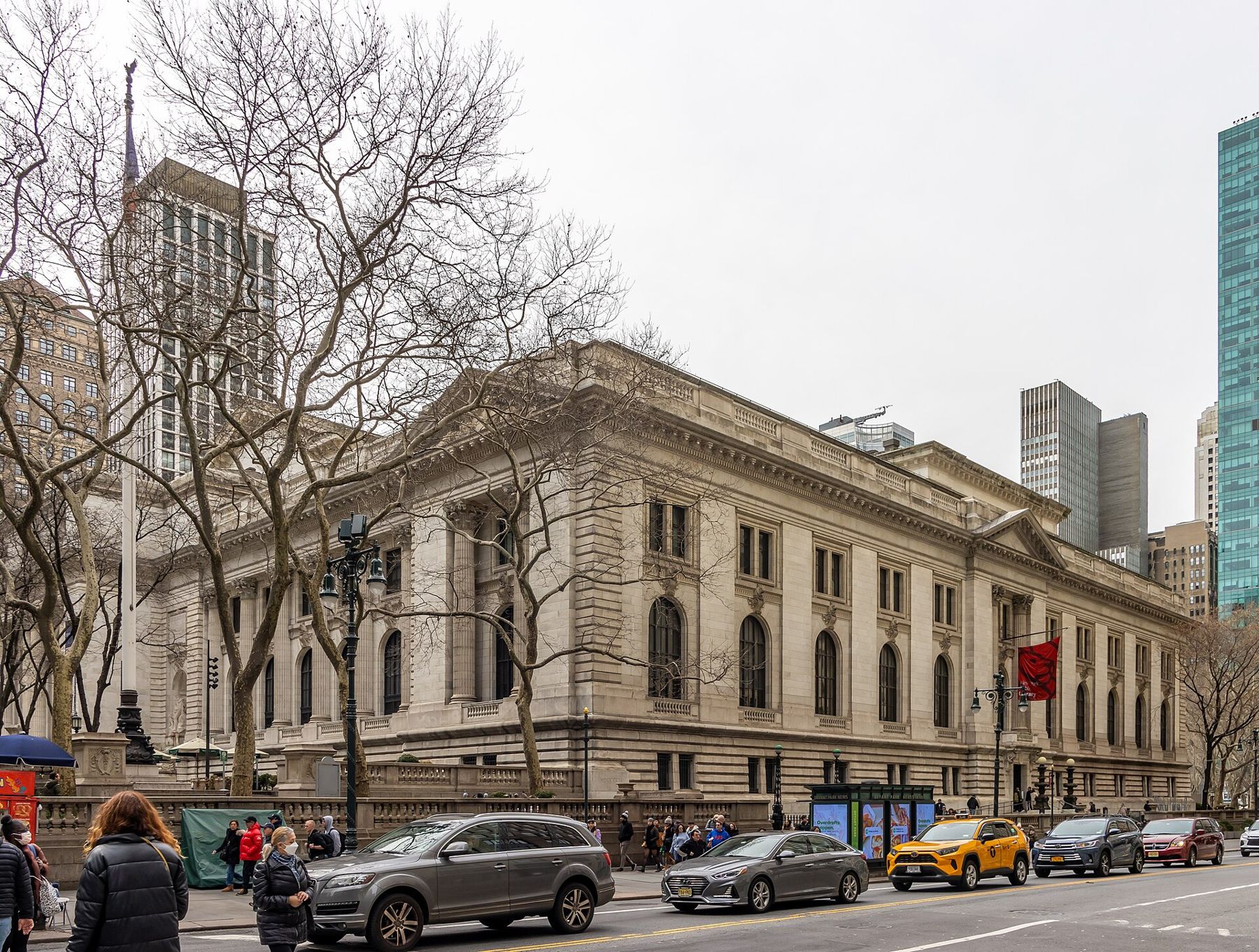
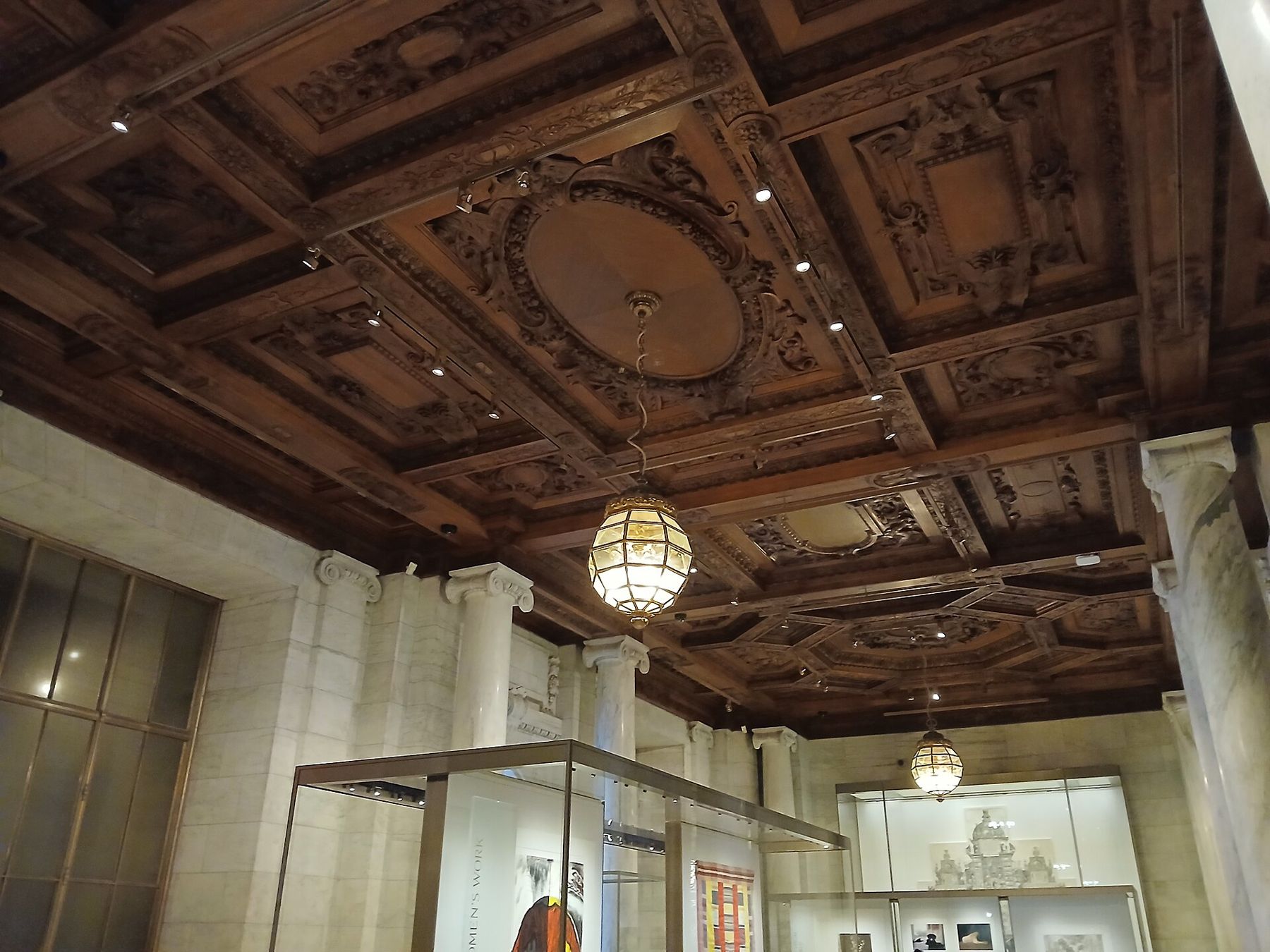
The building is a public library, and its main hall and exhibition rooms are generally open to visitors; check hours before you go. Inside, the marble continues, and some rooms add carved wood to the stone.
Reading limestone on the way north
Walk north from 42nd Street. Between the library and Rockefeller Center, many of the commercial buildings are faced with Indiana limestone, the most widely used building stone of its era in American cities. It comes from quarries in southern Indiana, and it is made largely of the broken shells and skeletons of tiny sea creatures cemented together. Step close to a ground-floor wall and look for those fragments: small specks, rings and fragments of shell in an even buff background.
Compare it in your head with the library marble. Limestone is softer, matte rather than glittering, and evenly coloured, with a slightly warmer tone. It carves beautifully but holds fine detail less sharply over time. Many of these buildings set the limestone on a base of granite, harder and speckled with larger crystals, where the wall meets the pavement. The change in material at knee or waist height is one of the easiest things to spot on the whole avenue.
Look up at window heads and cornices. Where a ledge shelters the stone from rain, you may see a dark crust; where rain washes the face freely, the stone stays pale. That pattern is explained in detail in how limestone weathers in city air.
Limestone · WalkGrand Central from Park Avenue and 42ndRockefeller Center
Between 48th and 51st Streets you reach Rockefeller Center, the great complex of the 1930s, and the clearest example of Indiana limestone used on a city scale. The buildings are faced in it from base to top, in long smooth vertical strips that run up between the windows, with no cornices and little ornament on the walls themselves. The stone is meant to read as a single pale skin, stretched tight.
Ornament is gathered at the entrances. Over the doorways, look for carved and cast relief panels, many with figures and inscriptions, some coloured or gilded. Walk into the Channel Gardens, the planted walkway that leads west from Fifth Avenue between two low buildings, and look at how the limestone frames the view toward the taller tower at the back. Then return to Fifth and find the bronze Atlas holding up the heavens in a forecourt between 50th and 51st Streets. The bronze against the pale limestone behind it is a good lesson in how metal and stone were combined.
Across the avenue stands St. Patrick's Cathedral, another white marble building, finished in the nineteenth century. Stand on the Rockefeller Center side and compare the two: the cathedral's marble a cooler white, the limestone opposite warmer and flatter.
The change in material at knee or waist height is one of the easiest things to spot on the whole avenue.
St. Thomas Church
At 53rd Street, on the west side, is St. Thomas Church, a Gothic Revival church of pale stone finished in the 1910s. It is a good place to see limestone carved in depth rather than spread thin. Look at the main doorway, with its pointed arch, its layers of mouldings stepping back into the wall, and the figures set in niches. Look at the single big tower at the corner rather than a pair. Unlike the smooth limestone of Rockefeller Center, this stone is cut into many separate pieces and ornaments, and the joints show the masons' layout.
The church is a working place of worship. You can enjoy the front from the pavement; if you go in, do so quietly and respect any services.
Up to Grand Army Plaza
Continue north to 59th Street, where Fifth Avenue meets the southeast corner of Central Park at Grand Army Plaza. Here the stone opens out into a public square. On one side is the Pulitzer Fountain, with stone basins and a bronze figure of Pomona, the goddess of abundance, on top. On the other side is the gilded equestrian statue of General William Tecumseh Sherman by Augustus Saint-Gaudens, led by a winged figure of Victory. The gold is bright against the green of the park and the pale stone around it.
Turn around before you leave and look back down the avenue. From here you can see the corridor you have just walked: a long canyon of pale walls in marble, limestone and granite, with dark windows in rows.
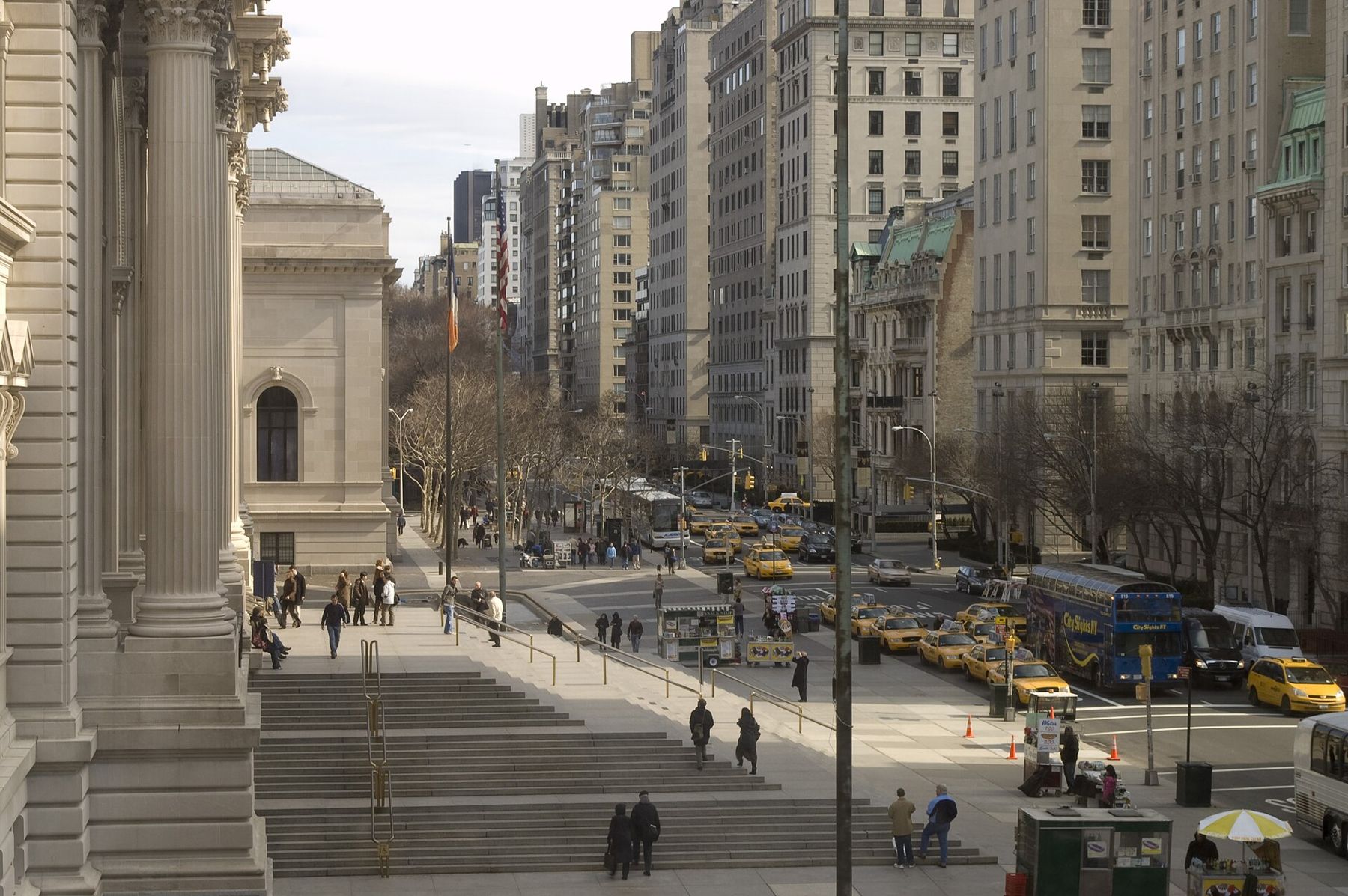
If you want to keep going, Fifth Avenue continues north along the park. Further up, around the Metropolitan Museum of Art, the apartment houses and museum fronts continue the same pale palette.
Grand Central is a short walk east of the library, and its south front makes a good prelude; see Grand Central from Park Avenue and 42nd. For a practical method you can use on any of these fronts, read reading a facade in five minutes.
Every photograph on this page is credited, with its licence, on Masons of the lens.