Grand Central from Park Avenue and 42nd
The terminal's south front is a stone triumphal arch for trains: Indiana limestone over a granite base, three great windows and a sculpture group crowned by Mercury.
- Neighbourhood
- Midtown
- On foot
- About 45 minutes
- Subway
- Grand Central-42 St, 4, 5, 6, 7, S
- Best months
- Clear mornings, any season
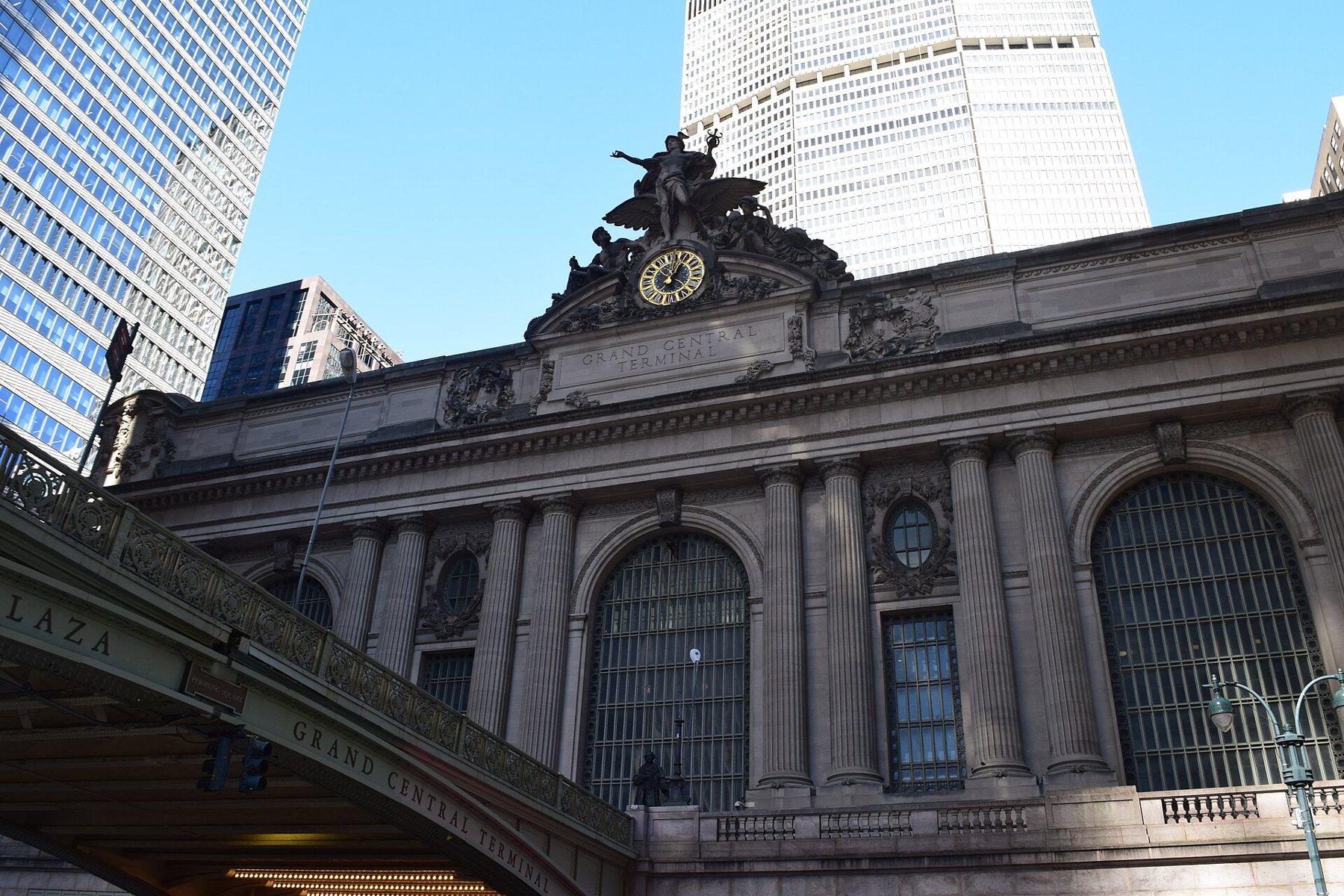
Most people see Grand Central from the inside, crossing the Main Concourse under the painted sky. The outside gets a glance on the way in. That is a pity, because the south front on 42nd Street is one of the best pieces of stonework in the city and one of the easiest to read. It was designed for a terminal that opened in 1913, by the architects Reed and Stem together with Warren and Wetmore, and it was meant to be seen from a distance, down the length of Park Avenue.
This walk circles the front from three points: the corner of 42nd Street and Park Avenue, the sidewalk under the Park Avenue Viaduct, and the stretch of 42nd Street west toward Vanderbilt Avenue. Mornings are best, when the sun comes from the east and catches the carving.
Two stones, one front
Begin on the south side of 42nd Street, opposite the terminal, and look at the whole front at once. It is built of two stones. At the bottom, in the base, is a darker, harder pinkish-grey granite from Stony Creek in Connecticut. Above that, everything is Indiana limestone, a pale, even, fine-grained stone that can be carved crisply and comes in very large blocks.
The split is practical as well as visual. Granite is tough, and at street level it takes knocks, salt, splashing and wear without much damage. Limestone is softer and easier to carve, so it does the decorative work higher up, where nothing can hit it. The same logic runs through hundreds of buildings in Midtown; Grand Central just does it on a very large scale.
A triumphal arch for trains
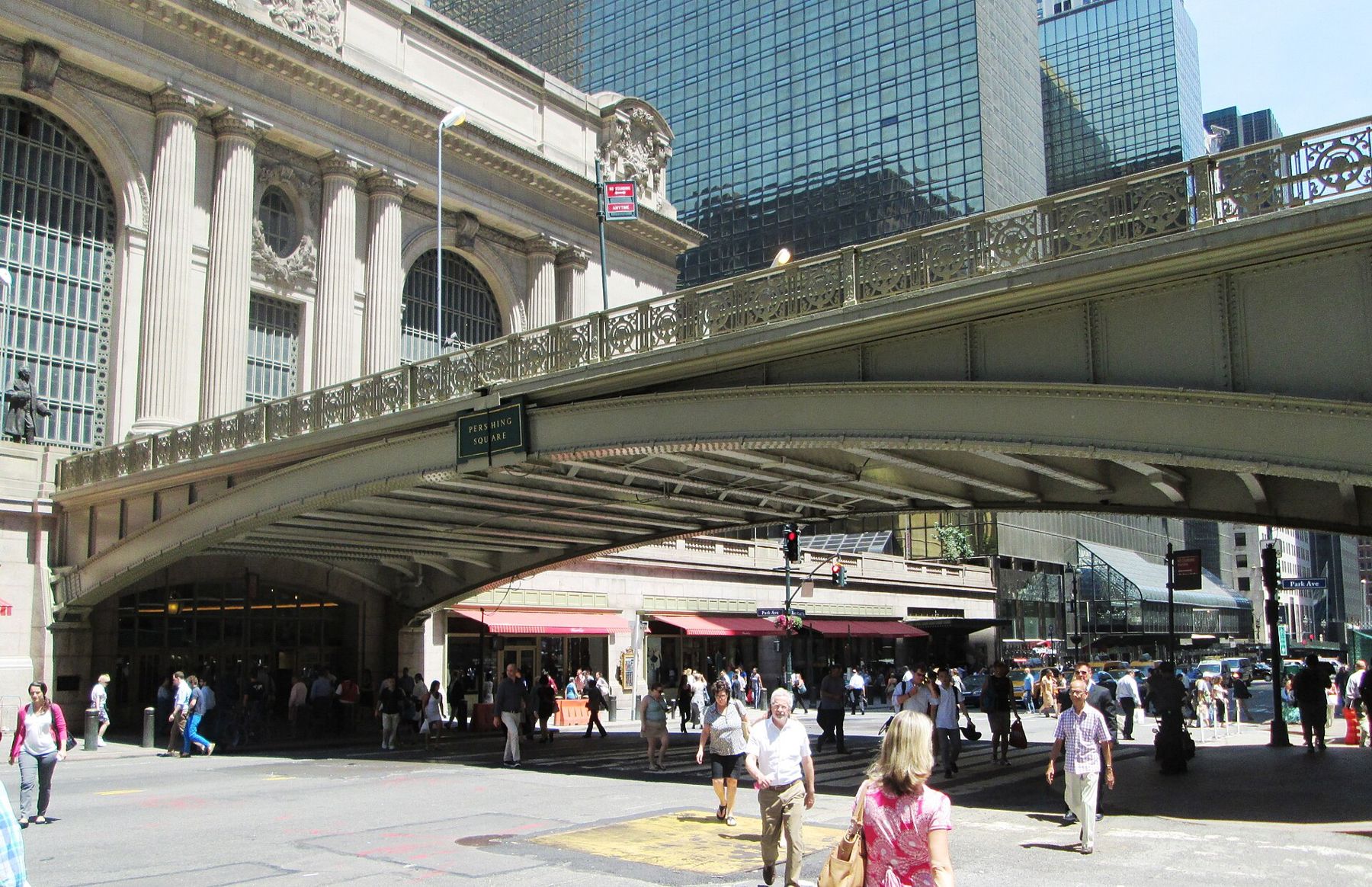
Now read the front as a composition. It is laid out like a Roman triumphal arch: three huge arched openings, each filled with a great window of glass and iron, set between pairs of tall fluted columns. Above them runs a deep band of stone, the entablature, and above that the attic, the plain wall at the top where an inscription and sculpture can sit. The message is that this is a gateway into the city, not a shed.
The great windows are worth a slow look. From outside they read as dark grids of iron and glass, but each one was designed to pour daylight into the great rooms behind. Between the windows, smaller round and oval openings are framed by carved wreaths and garlands, a lighter, finer kind of carving that shows how well limestone takes a chisel.
In front of the central window stands a bronze statue of Cornelius Vanderbilt, the railroad magnate, on a pedestal. It came from an older railway building downtown and was moved here some years after the terminal opened.
The clock and the Glory of Commerce
At the top of the centre bay sits the sculpture group usually called the Glory of Commerce, by the French sculptor Jules-Felix Coutan. Mercury, the god of travel and trade, stands in the middle with his winged helmet and arm flung out. On one side is Hercules, for strength; on the other Minerva, for wisdom. They are carved in limestone on a scale that only makes sense from far away: up close the figures are enormous.
Below Mercury is the clock, a big round face of coloured glass set in a stone frame. Look at how the sculpture wraps around it, with the figures reclining on either side. Seen from Park Avenue to the south, the clock and the group sit right on the axis of the street, which is exactly what the designers intended.
The message is that this is a gateway into the city, not a shed.Terracotta · Field noteTile overhead: the Guastavino vaults
Under the viaduct
Walk to the corner of Park Avenue. Here the street splits, and an elevated roadway, the Park Avenue Viaduct, rises over 42nd Street and wraps around the terminal so that traffic on Park Avenue can pass the building without stopping. Stand under it and look up at the structure: riveted steel girders, an ornamental iron railing along the top, and a curve that follows the line of the terminal behind.
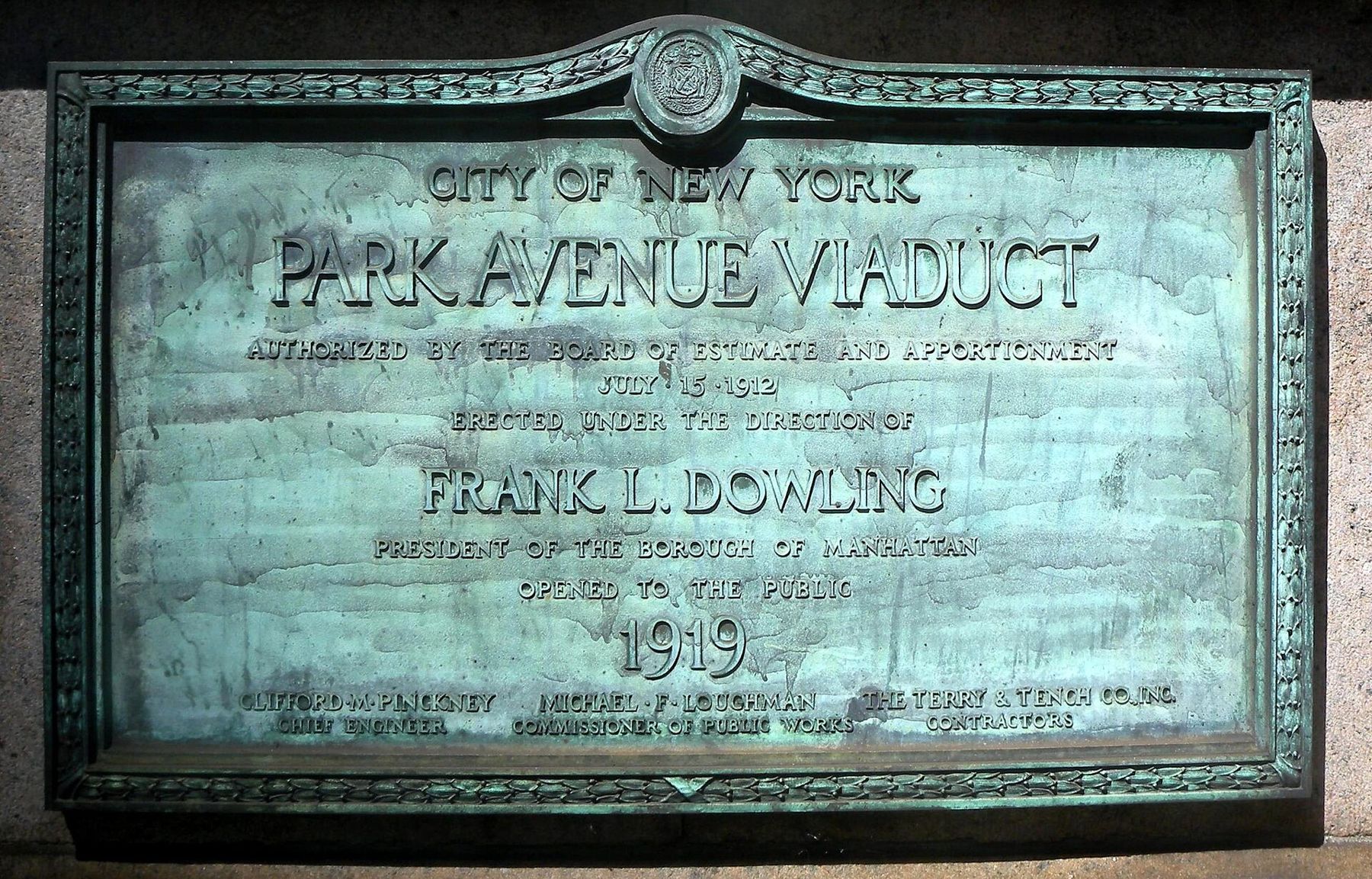
Along the stonework of the viaduct, look for a bronze plaque set into the wall. It records that the viaduct was authorised in 1912 and opened to the public in 1919. Its green patina, streaked where rain has run down it, is a small lesson in how bronze weathers, and it is one of the few date stones on this front you can read without binoculars.
From under the viaduct you see the terminal's flank at an angle, and the granite base becomes easier to compare with the limestone above. Notice how the granite is rougher and pinker, and how the joints between its blocks are slightly wider.
The landmark case
The front you are looking at nearly lost its setting. In the 1960s and 1970s the railroad's owners proposed building an office tower over the terminal, using the air above it. The city's Landmarks Preservation Commission, which had designated Grand Central a landmark, refused permission. The owners sued, and in 1978 the Supreme Court of the United States upheld the city's landmarks law. The decision became a foundation for landmark protection across the country, and it is why the south front still reads as a separate monument against the sky.
Behind the terminal you can see what the city already had by then: a large 1960s office slab that rises directly behind the clock. Compare its smooth, regular cladding with the carved limestone in front of it. The contrast tells the story of the case better than any summary.
A wide view down Park Avenue
On a few weekend mornings each summer, the city closes the viaduct to cars and opens it to walkers and cyclists. If you catch one, walk up the ramp from the south and see the front the way the designers imagined it, framed straight ahead, at the height of the clock. Check before you go; dates change each year.
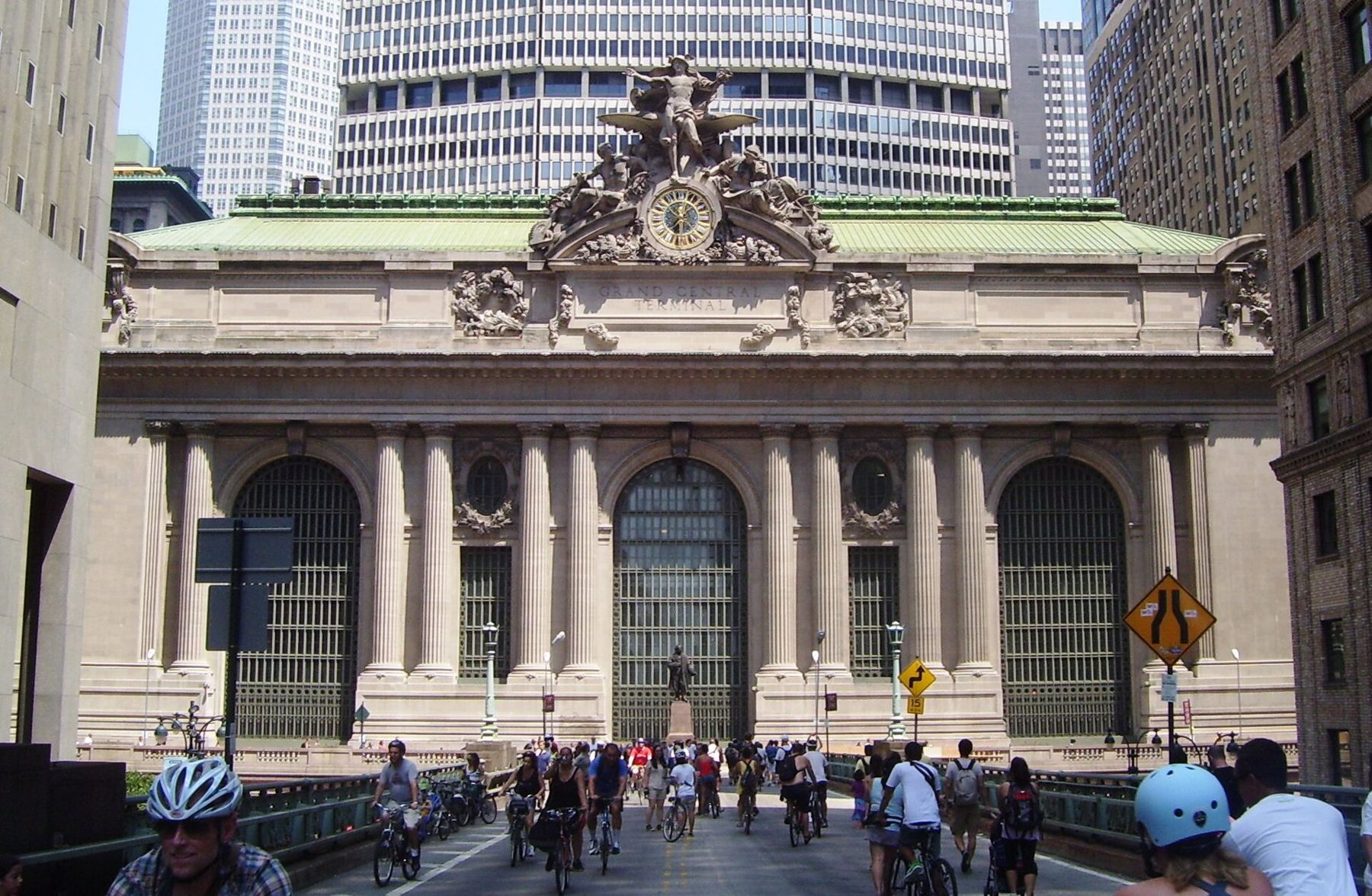
On other days, the best substitute is the sidewalk on Park Avenue a block or two south, where the viaduct ramp and the terminal line up. Then go inside. The Main Concourse is a public space, and the stone walls there continue the story.
For the tile vaults under the terminal, read the Guastavino vaults and look for the whispering gallery on the lower level. For more Indiana limestone, a short walk west brings you to Fifth Avenue and Fifth Avenue's pale mile. And for how this stone ages in city air, see how limestone weathers.
Every photograph on this page is credited, with its licence, on Masons of the lens.