Tile overhead: the Guastavino vaults
Thin layers of flat clay tile, laid in fast-setting mortar, hold up some of the most graceful ceilings in New York. Once you know the pattern, you find it everywhere.
- Neighbourhood
- New York
- On foot
- Half a day, three stops
- Subway
- Grand Central-42 St, 4, 5, 6, 7
- Best months
- Any month; mostly indoors
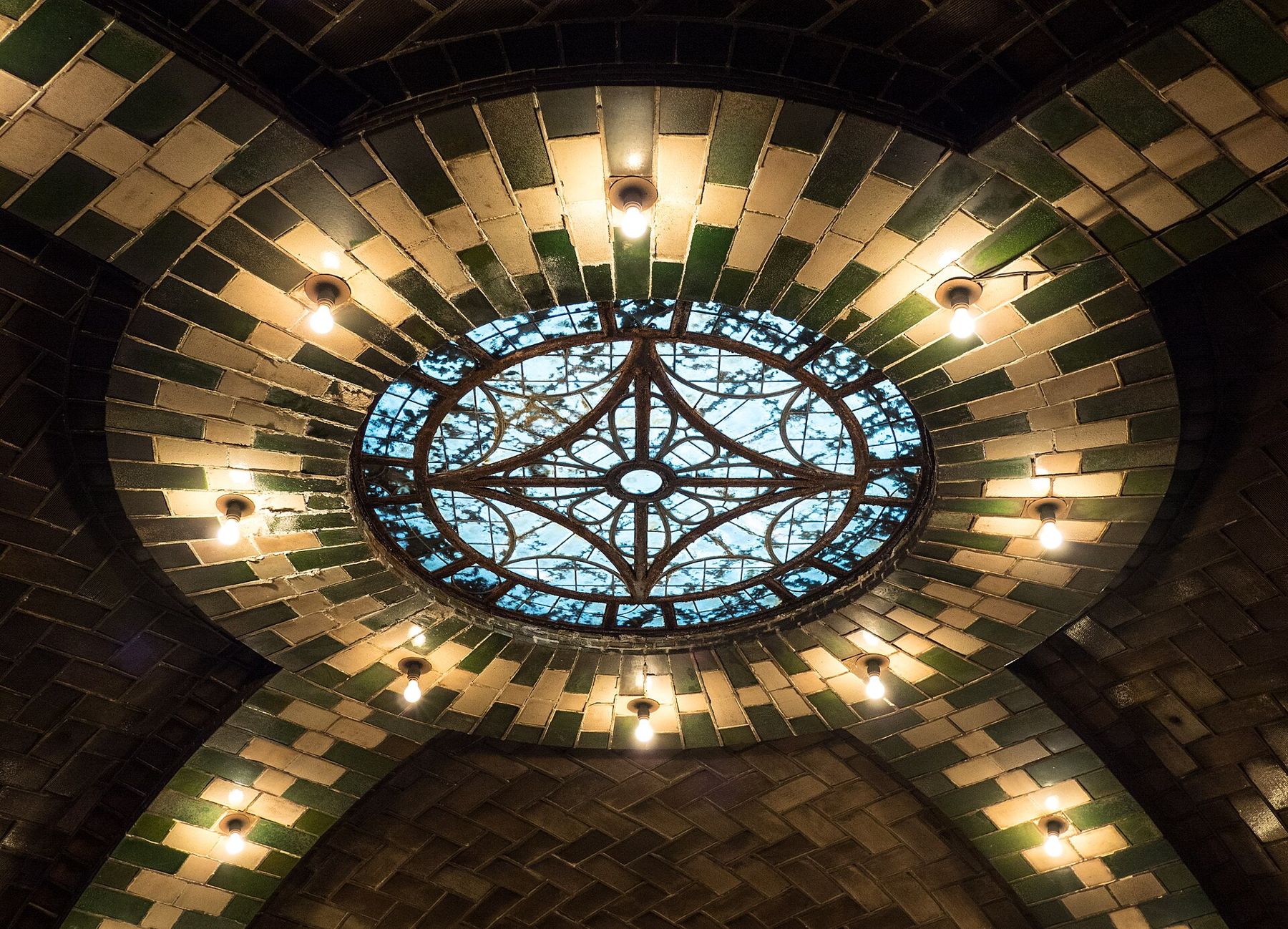
Look up in the right corners of New York and you will see ceilings that seem impossible: wide, shallow curves of buff tile with no beams, no ribs and almost no thickness, spanning spaces you would expect to need steel. Most of them are the work of Rafael Guastavino, a builder from Valencia who came to the United States in 1881, and his son, also named Rafael, who carried the business on after him. Their system of thin tile vaulting was patented, sold as fireproof construction, and used in hundreds of buildings across the country.
This guide covers three public places in New York where you can see it without asking anyone's permission, and explains how to read what is above your head.
How a tile vault works
A Guastavino vault is not a stone arch. It is built of thin, flat clay tiles, roughly the size of a hand or a book, laid flat against each other in several layers. The first layer is set with a fast-setting mortar that grips almost at once, so each tile can be stuck to the edge of the last one in mid-air. A mason can work outward from a wall with very little temporary support underneath. The next layers are laid over the first with the joints staggered and set in a stronger mortar, so the finished vault acts like a single curved shell.
The strength comes from the shape. A shallow dome or barrel vault pushes its load outward and down along the curve, keeping the tiles in compression, the state in which clay and mortar are strongest. The result can be only a few inches thick and still carry weight over a wide span. It also does not burn, which made it attractive in an age of fires.
The method has older roots around the Mediterranean, especially in Catalonia, where thin tile vaults had been built for centuries. What the Guastavinos added was engineering, load testing, salesmanship and a steady supply of tiles made to their own specifications.
Grand Central: the whispering gallery
Start at Grand Central Terminal. Go down to the lower level, below the Main Concourse, and find the low, vaulted space outside a restaurant door near the ramps. The ceiling here is a set of shallow tile vaults meeting at arches, with the tile laid in herringbone patterns that change direction from one curve to the next.
This is the whispering gallery. Stand in one corner of the space where an arch comes down, face the wall, and have a friend stand in the diagonally opposite corner and do the same. Speak quietly into the corner. The curved, hard surface carries the sound over the arch, and your friend will hear you clearly across a busy passage. It is a free physics lesson and a good way to feel how smooth and continuous the vault is.
The terminal is a working station. Keep clear of the crowds at rush hour and of the restaurant entrance itself; you need only the corners.
The Queensboro Bridge arcade
Next, go up to 59th Street near First Avenue, where the Manhattan approach of the Queensboro Bridge comes down to the street. Under the approach is a great vaulted space whose ceiling is lined with Guastavino tile in broad, curving bays. For years it served as a market hall; it was later closed off for a long period, then restored, and it is now partly occupied by businesses. How much you can see depends on what is open, so check before you go, but the vaults can often be glimpsed from the pavement.
Limestone · WalkGrand Central from Park Avenue and 42ndCompare the vaults here with Grand Central. They are taller and the bays are larger, but the language is the same: the tile laid flat, the herringbone pattern, the bands of tile that follow the edges of each vault, and the clean, beamless curve. The bridge itself is steel. The tile is a lining that makes the space beneath it feel like a room.
City Hall station on the 6 loop
The third stop is underground, and it is the most beautiful. City Hall station opened in 1904 as the showpiece of the city's first subway line. Its curved platform is roofed with Guastavino tile vaults in cream and green, with brass fittings and leaded glass skylights set into the ceiling. The station closed to passengers in 1945, largely because its sharply curved platform could not serve the longer trains then coming into use.
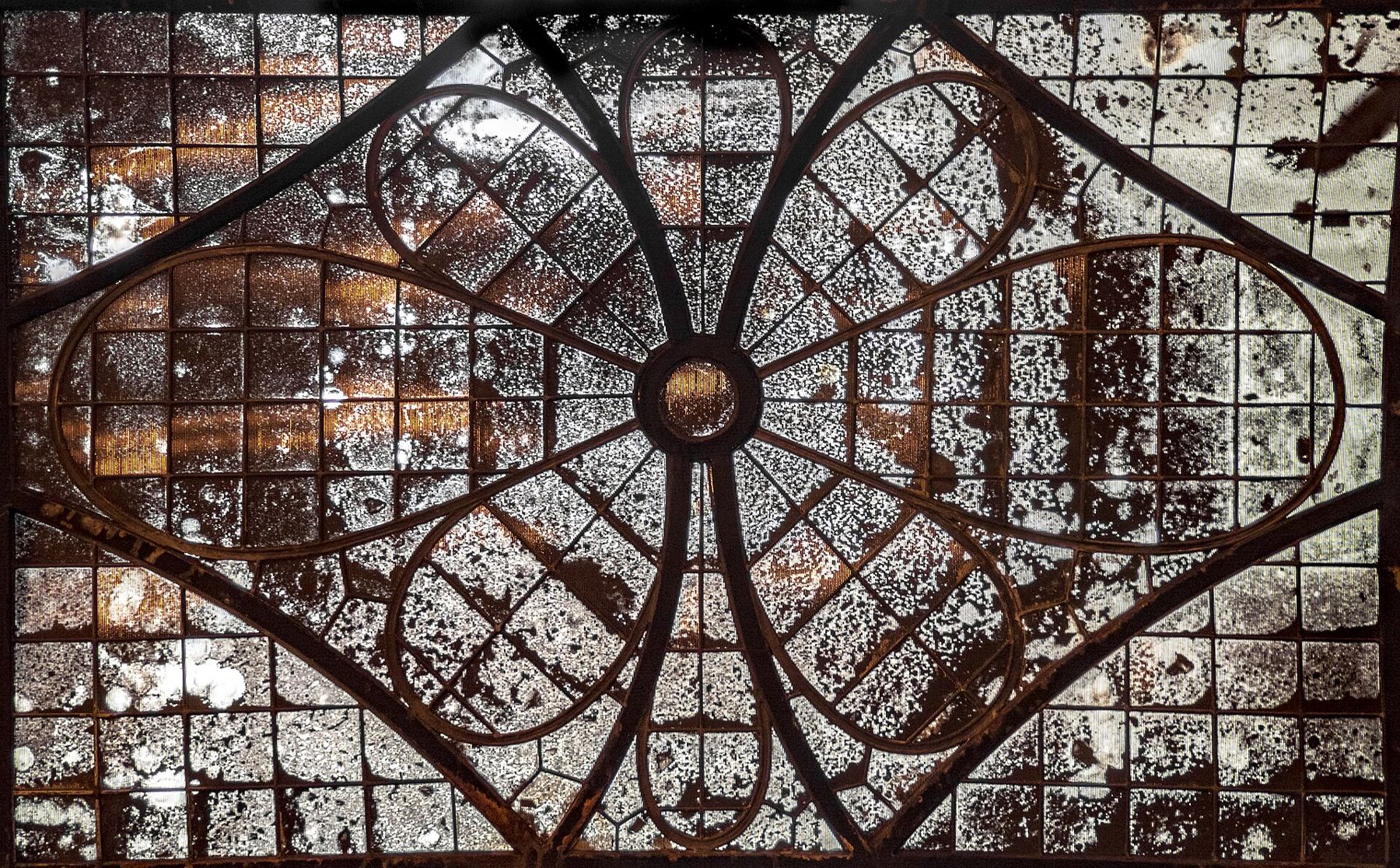
The station is not open as a stop, but downtown 6 trains still turn around through it on a loop after leaving Brooklyn Bridge-City Hall. Riders have been allowed to stay aboard for the loop and look out as the train passes the old platform. Rules and announcements change, so check current guidance before you try it, and follow any instructions from train crews. Watch out of the windows as the train slows into the curve. The city's transit museum has run occasional tours of the station; check before you go.
How to spot a Guastavino ceiling elsewhere
Once you have seen these three, you will start noticing the work in other places. The Registry Room on Ellis Island has a vast Guastavino tile ceiling. The Cathedral of St. John the Divine in Morningside Heights has tile vaulting at the crossing. Many churches, libraries, banks and public halls from the decades around 1900 have it in porches, stair halls and vestibules.
The signs are consistent. Look for tile laid flat to the curve rather than set on edge, in herringbone or basket patterns. Look for shallow domes and vaults that seem to float, with no ribs or beams. Look for bands of tile that run along the edges and corners of each bay, like the binding on a book.
If you want to read the stone around these ceilings as well as the tile, start with Grand Central from Park Avenue and 42nd, which looks at the terminal's limestone front. For terracotta on the outside of a building rather than overhead, the walk up lower Broadway begins right above City Hall station.
Every photograph on this page is credited, with its licence, on Masons of the lens.