Look up on lower Broadway
Cass Gilbert's Woolworth Building wears a skin of glazed terracotta made to look like carved stone. City Hall Park is the best seat in the house for reading it.
- Neighbourhood
- Lower Manhattan
- On foot
- About an hour
- Subway
- City Hall, R and W trains
- Best months
- Clear days in any season
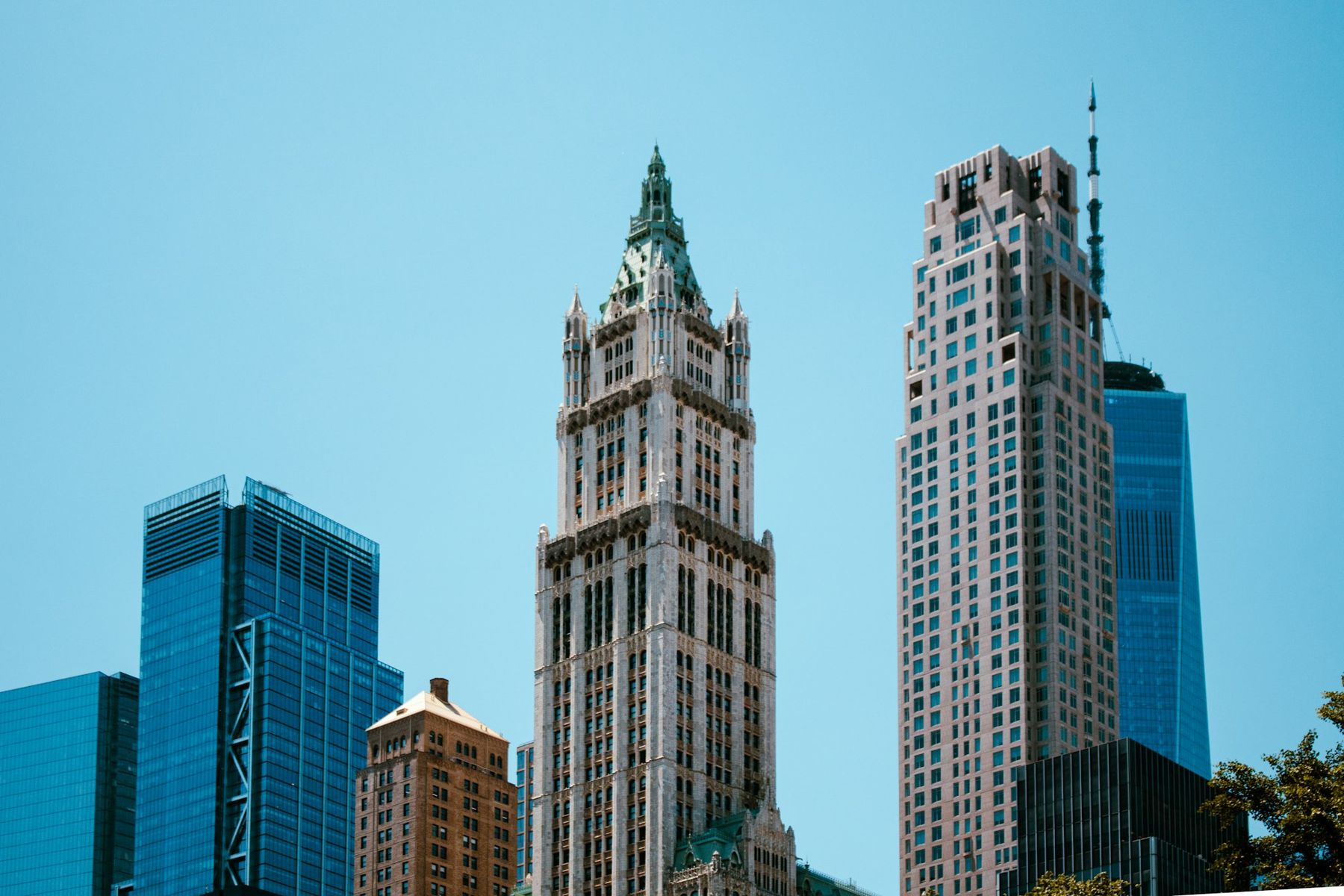
The Woolworth Building rises from Broadway opposite City Hall Park like a cathedral tower that kept going. When it was finished in 1913 to designs by Cass Gilbert, it was the tallest building in the world, and it held the title until 1930. From the park it reads as pale stone, carved into Gothic piers, pinnacles and tracery. It is not stone. Almost everything you see above the lower floors is terracotta, fired clay finished with a glaze, hung on a steel frame.
This walk is mostly standing still. Start in City Hall Park, move to a few points on Broadway and Park Row, and finish back on a bench with binoculars. The building's lobby is generally not open to casual visitors; if you hope to see inside, look for any tours and check before you go.
Why clay, and why make it look like stone
Terracotta solved several problems at once for a building of this height. It is much lighter than stone, which matters when every piece has to be carried by a frame forty and fifty storeys up. It does not burn, and after the great fires of the nineteenth century fireproofing was a selling point. It can be pressed into moulds, so a complicated Gothic ornament could be modelled once and produced by the hundred. And it is cheaper than carving the same shapes in limestone.
The glaze added one more advantage. A glazed surface is hard and slick, so soot and grime sit on it rather than sinking in, and rain helps rinse it. In a city that burned coal, that mattered. What the clay was meant to imitate was cut stone, the pale limestone and granite of older civic buildings, and the cream glaze was chosen to read as stone from the street. From City Hall Park, at that distance, the illusion still works.
Each piece went through the same sequence. A modeller shaped the ornament full size in clay, a plaster mould was taken from the model, and wet clay was pressed into the mould by hand. The pieces were dried, sprayed with glaze and fired in a kiln, then numbered to match setting drawings so that the masons on site knew exactly where every block belonged. A tower like this was, in effect, a giant assembly of numbered parts.
City Hall Park as a viewing deck
Enter the park from Broadway and find a place on the west side, near the fountain, where you can see the full height of the tower over the trees. City Hall itself, the small, elegant building in the middle of the park, makes a useful scale bar: it was finished in the early nineteenth century, a century before the tower, and it shows what a grand public building looked like when New York still built low.
Now read the tower top to bottom. The main block rises from Broadway as a broad slab, and from it a narrower tower climbs to a pyramid roof. Gilbert ran thin vertical piers all the way up, uninterrupted by horizontal bands, so the eye is pulled upward the way it is in a Gothic church. Near the top the piers sprout pinnacles and the windows get pointed heads and tracery, the stone-like ribs that fill the top of a Gothic window. Then the roof, sheathed in copper, now green.
What the clay was meant to imitate was cut stone, the pale limestone and granite of older civic buildings, and the cream glaze was chosen to read as stone from the street.
Colour at the top
Through binoculars the crown changes character. What looks plain cream from the ground carries colour higher up: blues, greens, buff and gold picked out in the glaze of the ornament, especially in the upper storeys of the tower. The colour was deliberate. At that height, plain white ornament would flatten into a blur against the sky; coloured glaze gives shadow and depth to details that nobody could otherwise see.
Look also at the shapes. Gothic ornament in stone is carved by hand, and no two pieces are quite the same. Here the same crocket, the leafy knob along the edge of a pinnacle, repeats exactly from one corner to the next, because it came from the same mould.
Terracotta · WalkBleecker Street's white towerClose up on Broadway
Cross to the Broadway side and stand near the base, looking straight up the face. This view shows the piers as long ribs running into the sky, and it shows something else: the surface is not one even colour. Unit by unit, there are slight differences of shade, some creamier, some greyer, some with a different sheen. That patchwork is a record of maintenance. Terracotta blocks are fixed to the steel with metal anchors, and when water reaches those anchors they rust, swell and crack the clay. Over the decades many units have been repaired, cleaned or replaced, and new pieces never age quite like old ones.
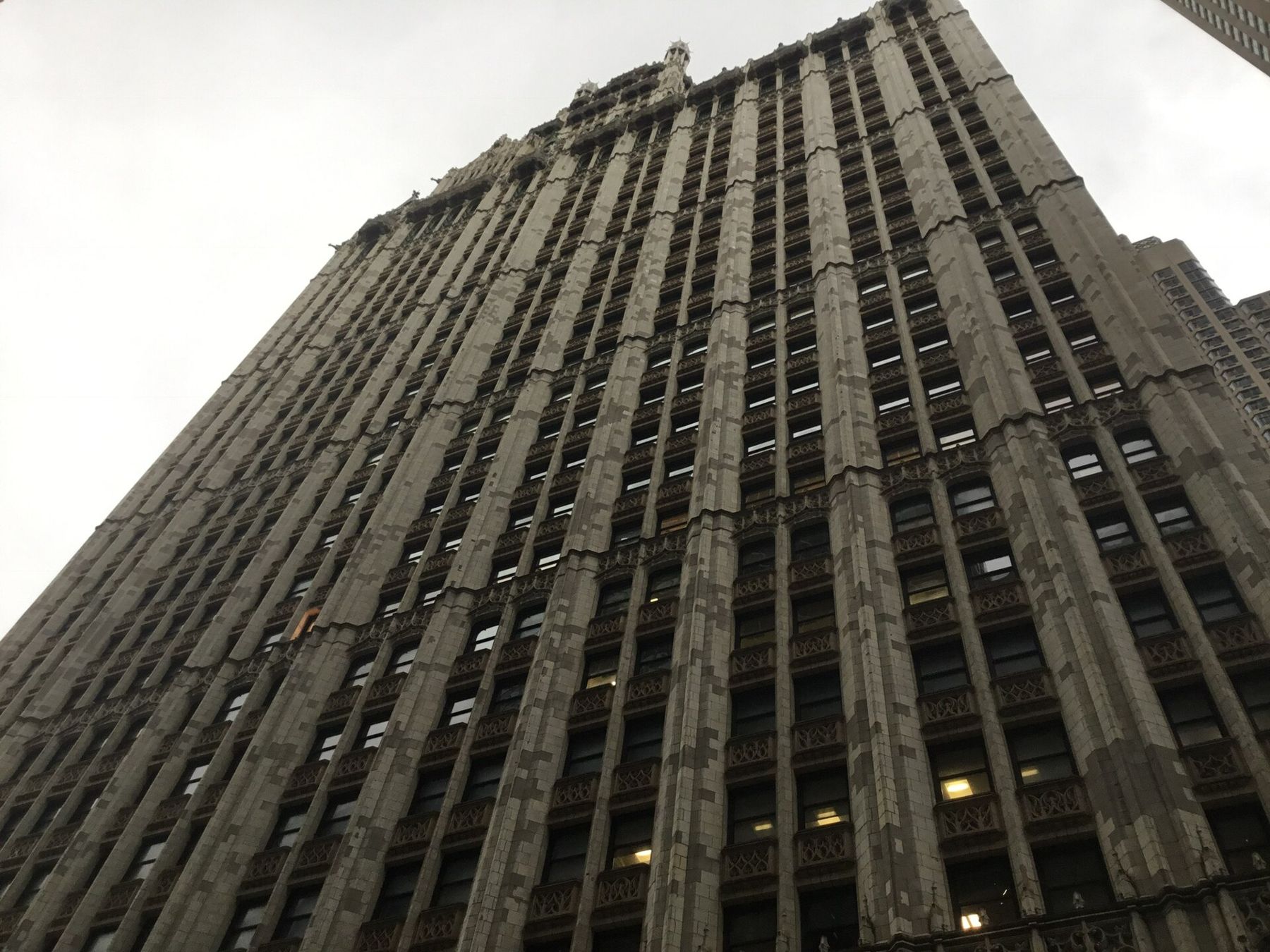
Look at the joints, too. They are thin and very regular, much finer than the joints between stone blocks, and they outline units that are small compared with stone. Once you see the grid, you cannot unsee it, and the building turns from carved masonry into a skin of thousands of fitted tiles.
The neighbours
Walk south along Broadway and then turn onto Park Row, on the east side of the park. Lower Manhattan around City Hall Park was where New York first built tall, and the blocks here mix materials freely: brick, granite, limestone and more terracotta, glazed and unglazed. The Park Row Building, with its two cupolas, was among the tallest buildings in the world when it opened at the end of the 1890s, and it shows how the earlier generation of towers handled height, with a busier, more stacked front than Gilbert's clean piers.
Further along Park Row, the older Potter Building is a good comparison for the material. Its terracotta is red-brown and heavily modelled, and it sits beside brick in the way terracotta was first used in New York: as trim rather than as a whole skin. Set it against the Woolworth Building and you can see in one glance how far the material travelled in a generation, from decoration to cladding.
Back to the bench
Finish where you started, in City Hall Park, and take one last look at the tower in the late afternoon, when low sun from the west lights the Broadway face and the glaze glows warmer than limestone ever would. That warmth is the one thing that gives the clay away at a distance.
If you enjoyed reading terracotta, the white tower of the Bayard-Condict Building on Bleecker Street shows the same material at a smaller scale and in a very different spirit. City Hall Park also sits right above the old City Hall subway station, whose tile vaults are covered in the Guastavino vaults. And for the real stone that terracotta was copying, the walk along Fifth Avenue's pale mile is the natural next step.
Every photograph on this page is credited, with its licence, on Masons of the lens.